International Criminal Court · ICC-01/09-01/11
Why Ruto and Sang stood trial and why it stopped
ICC prosecutors alleged a coordinated campaign of murder, forcible displacement and persecution in the Rift Valley. A divided court ended the trial in April 2016.
ICC pretrial confirmation
ICC trial record
View original editorial graphic
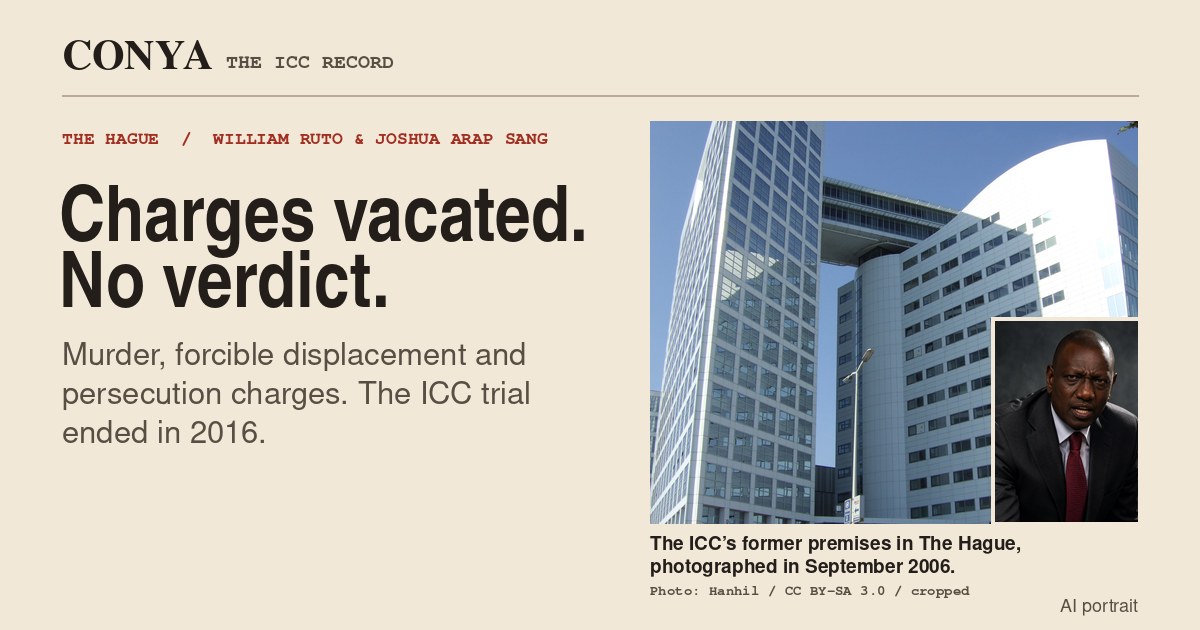
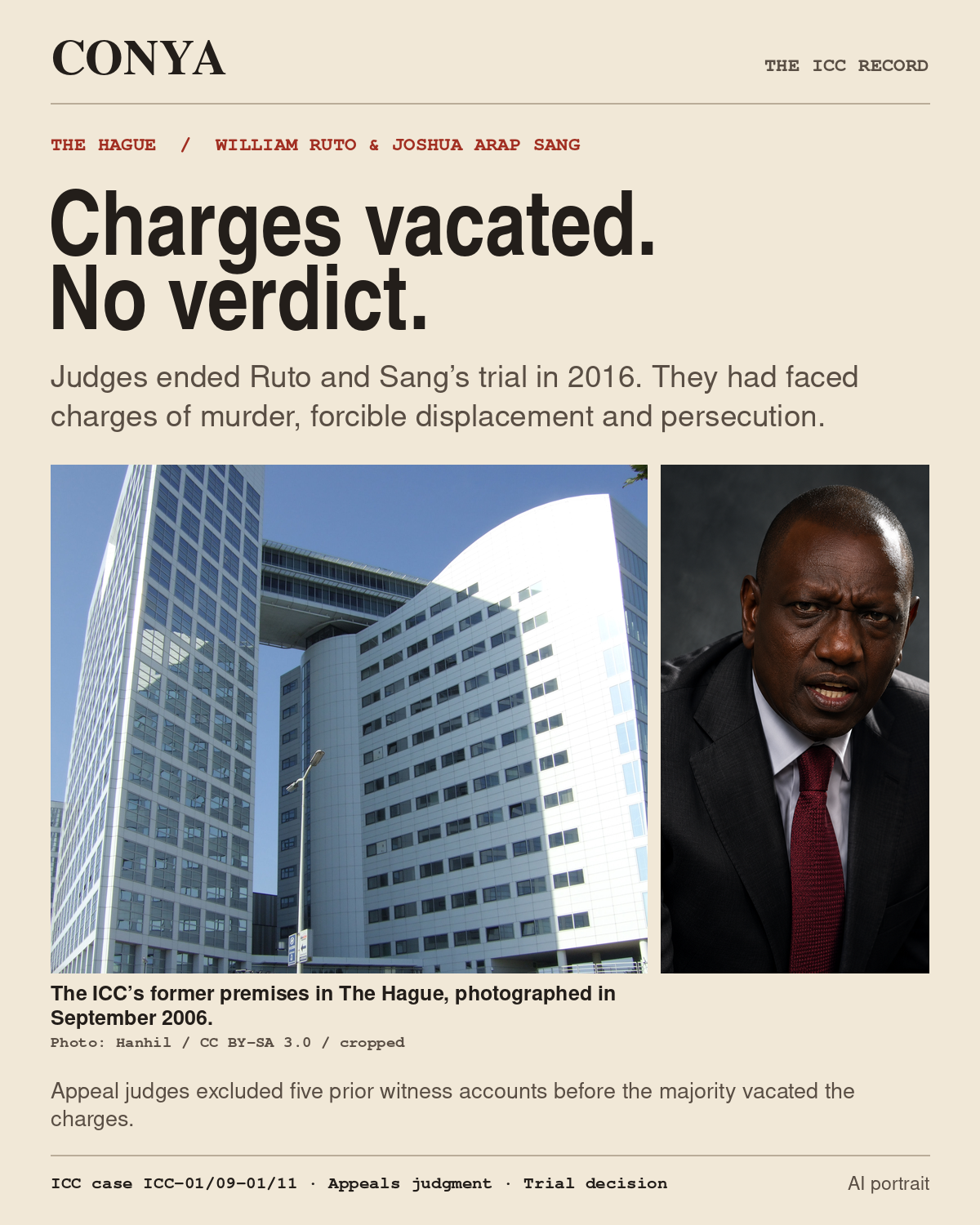
Original CONYA editorial graphic · AI portrait, not an archive photograph or evidence of an individual’s responsibility.
The ICC’s former premises in The Hague, photographed in September 2006. Photo: Hanhil / CC BY-SA 3.0 / cropped · Optional third-party graphic source ↗ · License ↗
Download portrait card ↓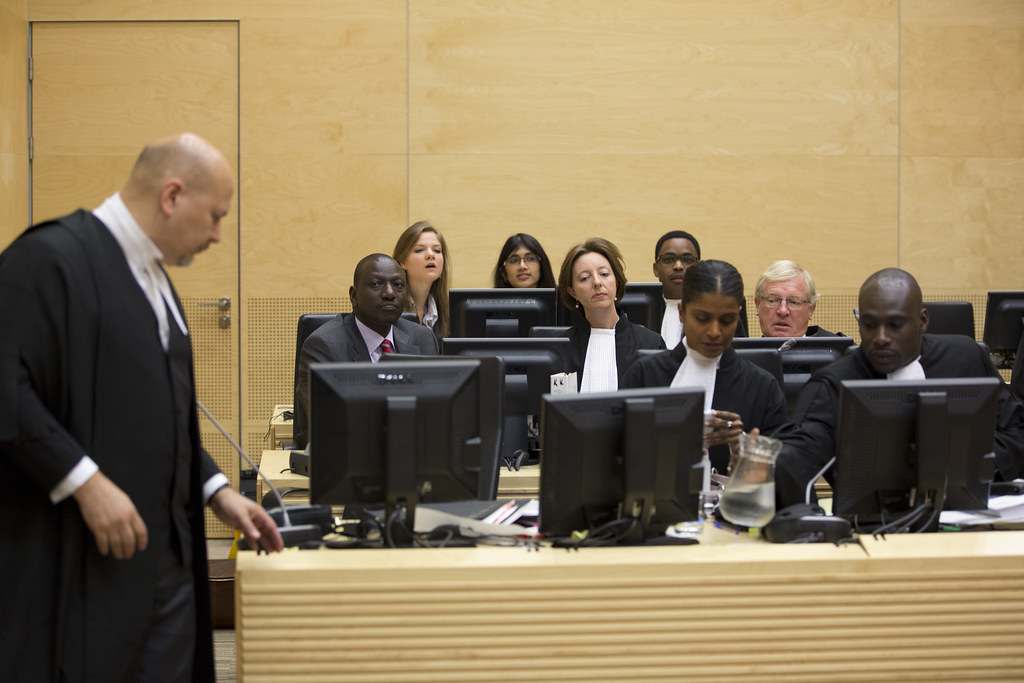
Three categories of crimes against humanity
In January 2012, a pretrial majority confirmed charges against William Ruto and broadcaster Joshua arap Sang. The prosecution alleged that Ruto helped organise a network to attack civilians perceived to support Mwai Kibaki’s PNU. It alleged that Sang helped coordinate or encourage the attacks through Kass FM. The case included attacks in Kiambaa and other Rift Valley locations.
The judges declined to confirm charges against Henry Kosgey. Ruto and Sang pleaded not guilty when the trial opened on 10 September 2013. The prosecution closed its case two years later after presenting evidence from 30 witnesses, including two experts. On 17 September 2013, BBC News reported that a witness identified as 536 testified behind a curtain to protect her identity.
Claim provenance: [1] ICC case page [2] Pretrial confirmation [3] BBC News, protected Kiambaa witness testifies at ICC, 17 September 2013
Five earlier witness accounts were excluded
Trial judges had admitted earlier recorded accounts from five witnesses for the truth of their contents under amended Rule 68. In February 2016, appeals judges reversed that decision. They held that the amended rule could not be applied retroactively to the accused’s detriment. The earlier accounts were therefore unavailable as substantive evidence when the chamber considered whether the case should proceed.
Claim provenance: [4] ICC appeals judgment, 12 February 2016
The judges split over the evidence
Judge Robert Fremr concluded the prosecution had failed to produce evidence capable of supporting convictions. He saw evidence of local organisation but found the alleged network and defendants’ responsibility were inadequately supported. Judge Chile Eboe-Osuji agreed the proceedings should stop and treated the result as a mistrial in light of witness interference and political meddling. Judge Olga Herrera Carbuccia dissented, concluding the case should proceed.
The majority vacated the charges on 5 April 2016 without a verdict or formal acquittal. It left open the possibility of fresh prosecution. Eboe-Osuji found direct interference with at least four witnesses and said the evidence then before the court did not show that Ruto or Sang instructed or encouraged it.
Claim provenance: [5] ICC corrected decision and dissent [6] ICC summary of decision [7] Prosecutor’s response
Later public roles
William Ruto became Kenya’s president in 2022. In August 2023 he appointed Joshua arap Sang to a public communications role in the executive. The Star documented Sang leading a government project inspection as a director of public communications in January 2026. His status in November 2026 could not be independently verified.
Claim provenance: [8] Kenya’s Office of the President [9] The Standard, Sang’s appointment, August 2023 [10] The Star, January 2026
Footnotes & source documents
- ICC case page ↗
- Pretrial confirmation ↗
- BBC News, protected Kiambaa witness testifies at ICC, 17 September 2013 ↗
- ICC appeals judgment, 12 February 2016 ↗
- ICC corrected decision and dissent ↗
- ICC summary of decision ↗
- Prosecutor’s response ↗
- Kenya’s Office of the President ↗
- The Standard, Sang’s appointment, August 2023 ↗
- The Star, January 2026 ↗
Further optional archive
Initial appearance at the ICC
Official courtroom photograph of William Ruto, Henry Kosgey and Joshua arap Sang, 7 April 2011.
International Criminal Court
Link to publisher
Content warning: this optional external archive may contain disturbing accounts or imagery of violence. Third-party content loads only when activated.
Open original archive ↗Defence opening arguments
Official video of the 2013 Ruto–Sang trial opening. Ruto’s lawyer played a contemporaneous TV clip and argued it showed his client calling for peace.
International Criminal Court
Link to publisher
Content warning: this optional external archive may contain disturbing accounts or imagery of violence. Third-party content loads only when activated.
Open original archive ↗